Southwest Florida’s warm, humid climate is hard on fencing materials that aren’t built for it — untreated wood warps and rots faster here than in drier climates, which is why most local installers default to either pressure-treated pine with a protective seal, or vinyl, which doesn’t absorb moisture at all.
Lee County requires a permit for most fence installations over 6 feet in height, and HOA-governed subdivisions across Fort Myers frequently restrict fence style, height, and color — always confirm your neighborhood’s rules before choosing a non-standard material or finish.
Installation timelines here run faster than northern markets: because there’s no winter freeze to work around, most privacy fence projects can be scheduled and completed within 1–3 weeks of a signed estimate, year-round.
What’s typically included
- Site survey and property line confirmation
- Permit filing where required
- Post-hole digging and concrete setting rated for Florida’s sandy soil
- Gate hardware and self-closing latches where pool-adjacent
Wood vs. vinyl: how to actually decide
This is the most common question we get on a first estimate, and the honest answer depends on the property:
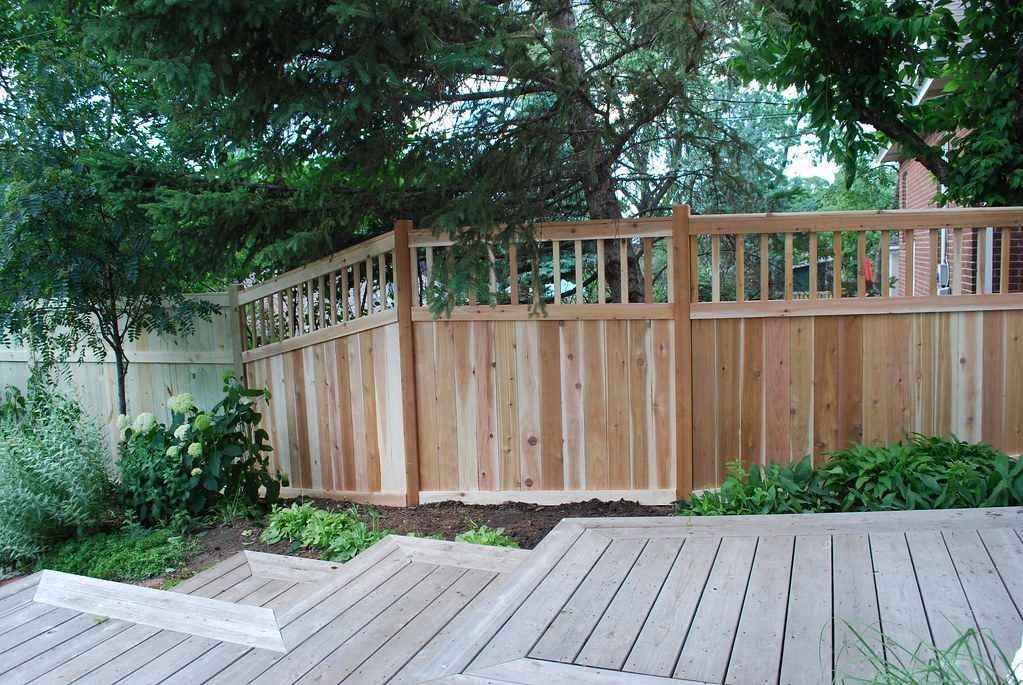
Pressure-treated wood costs less upfront and is easier to customize (stain color, board spacing, height variations), which matters in older Fort Myers neighborhoods with irregular lot lines or mature landscaping that a rigid vinyl panel system doesn’t handle as gracefully. The tradeoff is maintenance: wood needs re-sealing roughly every 2–3 years in this climate to keep humidity from causing warping, splitting, or rot at the post base — the ground-contact point where Florida’s moisture does the most damage.
Vinyl costs more upfront but needs essentially no sealing or repainting, which is why it’s become the default for homeowners who want to install once and not think about it again. It also doesn’t provide the same customization flexibility — vinyl comes in fixed panel systems, so oddly-shaped or sloped yards sometimes need more site-specific engineering to fit cleanly.
Neither option is objectively “better” — it’s a tradeoff between upfront cost and long-term upkeep, and we walk through both with real numbers for your specific yard rather than a generic recommendation.
Our installation process
- Site survey and layout — we confirm the property line, call in utility locates through Sunshine 811, and note any HOA-restricted design requirements before ordering material.
- Permit filing — for fences over 6 feet, we file with Lee County on the homeowner’s behalf and schedule around inspection timing.
- Post-hole digging and setting — footings are sized and set for Florida’s sandy soil composition, which drains differently than clay-heavy soil up north and affects how deep and wide footings need to be for the fence to hold under storm-season wind.
- Panel or board installation and gate hardware — for pool-adjacent sections, self-closing gate latches are installed and tested to meet Florida’s pool barrier requirements, not just standard gate hardware.
- Final walkthrough — we check the full line with the homeowner, including gate swing, latch function, and any grade transitions before calling the job done.
Maintenance and care
- Wood: re-seal or re-stain every 2–3 years; check post bases annually for early signs of rot, especially after hurricane season when ground saturation is highest.
- Vinyl: rinse periodically to clear salt air residue near the coast; check gate hardware every six months, since humidity affects closing tension over time.
- Both materials: keep sprinkler heads angled away from the fence line — constant direct water exposure accelerates wear on wood and can cause mineral staining on vinyl.
What affects your price
Cost depends on total linear footage, material choice (wood generally costs less per foot than vinyl, before factoring long-term maintenance), height (fences over 6 feet require permitting and typically heavier posts), number of gates, and site conditions — a yard with mature trees, slopes, or irregular lot lines takes longer to install than a flat, open rectangle.
The photo above is a style example illustrating this type of privacy fencing, not a completed project at a Fort Myers address. Real project photos will be added as local jobs are completed.
Get a quote
Fill out the form on this page or call to schedule a free on-site estimate.